Blog
A space for learning.
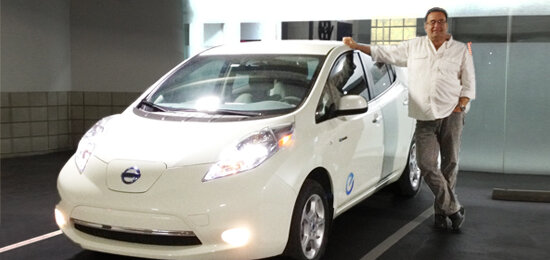
David W. Maximizes the Range of His Electric Vehicle
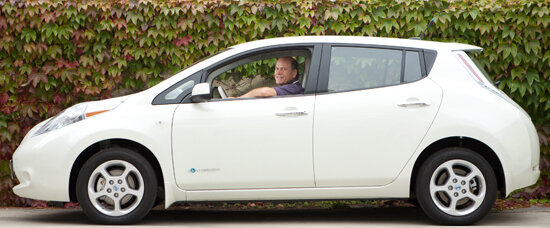
I purchased my Nissan Leaf in March 2011. I couldn’t resist the appeal of zero emissions, cool styling, fun driving, green status, well-engineered and built car, and a 100 mile range. I must say it has delivered on all of these promises, with the exception of the range. For me, range has been a bit problematic because I live in Santa Barbara, and I have an office in Hollywood. My commute is 92 miles door-to-door. I thought, I’d have 100 miles of range, so hey, no problem.
Real life experience
Well, here’s my real life experience over the last year or so. Fortunately, I don’t make that commute every day, only once a week. I have a loft in L.A. so I stay for a few days, mid-week, and drive back to S.B. for 4-day weekends. Bottom line -- I have made the 92 mile commute on a number of occasions, but on many of the trips I’ve had to avail myself of one of the four Nissan dealers along my route for a free, level 2 charge, stopping anywhere from 30 to 60 minutes at a time. Adding an hour, to an hour-and-half commute is not a lot of fun. (With a one hour charge, I can pick up about 12 miles of additional range).
Factors
I’ve learned about range anxiety first hand. It sits right under one’s sternum, something that pilots and race car drivers know all too well. I’ve also learned there are a number of factors that affect the range I am able to get on each trip such as:
- Driving mode – eco mode or regular
- Driving style – lead foot, or with an egg between your foot and the accelerator
- Terrain – along my route I climb the 800ft Conejo Grade
- Temperature – the Leaf cools it’s works, but no heating
- Load – weight of passengers and cargo
- Accessories – heat, AC and lights
- Solar charger on the rear wing
- Altitude – thinner air in certain locations
- State of charge
- Speed
Tactics to extend range
I’ve come to learn that the largest factor is aerodynamics. Even though the Leaf is nicely shaped to cut through the wind, and even deflect it around the side view mirrors with its bubble-lensed headlights, pushing all that air out of our way takes lots of energy. So the faster we go, the harder we have to push against all that air. (Race car drivers know that at top speeds it takes an enormous increase in horsepower to gain just a few more MPH.)
I’ve come to learn this in two ways. I can make my 92 mile commute without having to stop for a charge if I draft a big rig truck down the coast. I let the trucker push the air out of my way with his fossil fuel. I don’t recommend this practice as it’s just as nerve racking as the range anxiety I’m trying to overcome. It’s also dangerous and you’re likely to pick up your share of rock chips.
The second way, is on the days I’ve hit stop-and-go traffic along the 101, I can make the 92 miles, by poking along well under the speed limit. However, if the traffic is moving along at a clip, it’s also a bit dangerous to try to go 50 mph with traffic zipping by you at 70.
Since I am trying to make my commute without stopping, I’ve also over inflated my tires by four or five pounds, tinted the windows so I can leave the AC off and added some GasPods along the rear roofline. I don’t know if they help, buy hey, any bit helps and I only need just a few more miles.
DC Quick Charging Stations
With just one DC quick charger along my route I’d be set. In the same time it takes one to pump a tank of gas, use the restroom and grab a beverage for the road, I can pick up enough range to make my commute comfortably. All I need is 10 minutes on a DC quick charger, and I’m home free. I hear there are charging station companies evaluating DC quick charging stations along my route. I can’t wait!
Hidden Dangers
On a side note…. there is a hidden danger of using the level 2 chargers. I stopped at the Nissan dealer in Camarillo for an hour to gain some additional range. I was feeling good about picking up 50 cents worth of free electricity courtesy of Nissan, until I realized I was walking back to my car from Frys Electronics having just spent $200! A month or so later the same thing happened when I used the free charger in front of the Malibu Public Library and walked over to the Cross Creek Shopping Center and spent $150 on clothes. This is something that is not mentioned in the owner’s manual. So beware. (However, I’m up to speed with my tech toys and I’m better dressed thanks to my Leaf’s need for more juice.)
See you on the 101!



CEC Joins "SB Reads" to Quack about Plastic
When Moby-Duck author, Donovan Hohn, heard about the mysterious loss of 28,800 bath toys at sea, he figured he would interview a few oceanographers, talk to a few beachcombers and read up on Arctic science and geography. Little did he know that he would be pulled into the mixed-up worlds of renegade beachcombers, Alaskan non-profit politics, Chinese toy manufacturers, and a massive environmental problem.


Jay H. soaks up the sun with solar panels
I have quite a bit of experience with solar systems in terms of remote telecommunications facilities where utility power isn't practical. These involve large battery banks and over-engineering to ensure reliable power for radio, microwave, and telephone relay stations that need to be up 24/7.
So, the idea of a solar system in a suburban area with plentiful utility power didn't make sense to me at first. Electricity is readily available at reasonable rates. It would be satisfying but not practical to pull the plug on Edison.
Then, I stumbled across a mention of solar "co-generation" on Southern California Edison’s website. Co-generation is when a customer connects a source of power such as solar or wind into the electric grid. With solar, California supplies a rebate to pay part of the cost, and the federal government provides an additional tax credit.
On further research I found the idea of co-generation kind of exciting. I can use the entire utility grid as my energy storage. I don't need a battery and I don’t need to design the system any bigger than my load.
I was also considering my electric vehicle (Chevy Volt). I decided the convenience of the 240-volt charger was worth it. Rebates cover half the cost of the charger and installation. If I came home from a day trip with a depleted battery I could plug in for a couple of hours and then go out to dinner on electricity. However, the Volt would be away from home when my solar panels would be generating power from the sun.
With co-generation, I just produce more power than I need when the sun shines, feed it to Edison, and then pull power from Edison at night to run my home and charge the car. I also switched to a rate plan that gives me much lower electric rates at night and credits me at higher rates in the daytime when the sun is shining and I'm producing electricity. Some friends were predicting that the Volt would cause my electric bill to skyrocket –ha!
[Click image to see more...]
As luck would have it, I have a great roof for solar. It is south-facing and doesn't have any vents or obstructions. I had enough area to install panels that could generate about 4kW peak power. I'm good with my hands and have a lot of experience with wiring and electrical things. My initial plan was to install the solar as well as the level 2 car charger myself.
I quickly changed my mind about installing the solar because I'm not comfortable with the permit process and roof penetrations kind of scare me. I shopped around and chose Coastal Constructors to provide the hardware, do the mechanical work and take care of the permit paperwork. They did the wiring at the same time as they wired the charger, and everything passed inspection. Modern panels are a lot better looking than the earlier ones. I'm very happy with the appearance as well as the performance.
Another modification I considered was the inverter systems. Most grid-tied systems connect a number of panels in a series string to produce high-voltage DC, and then put in a large wall-mounted inverter to convert this to conventional AC power. I was not excited about this design. A fault in one panel can bring down a whole string. Due to the high DC voltages, the wiring is complicated.
I discovered a company in the Bay Area, Enphase, that does things differently. They manufacture micro-inverters. Each micro-inverter handles the output from one solar panel. One mounts underneath each panel and they connect in parallel. If one panel or inverter goes bad, the rest of the array keeps going. The DC wiring is low-voltage and needs no conduit.
In addition, my solar system has its own website that not only shows real-time and historical data for every panel, but can also alert me if there's ever a problem. If there's debris such as bird droppings on or an electrical problem affecting one panel, the other panels are not affected, and I get an email describing the issue and showing me which panel is in trouble.
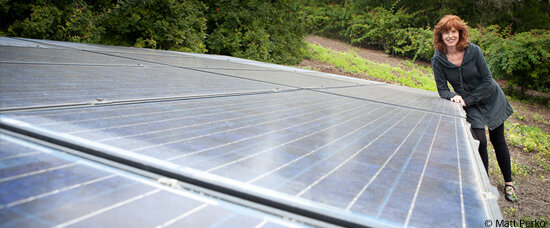
It's now been in service for almost 10 months. I've ”banked” a bit over 6 megawatt-hours of electricity with Edison. Carbon offset a bit over 4 tons. Every month since installation I've produced more electricity than I've consumed. Not only am I driving on daylight, I'm powering my house with it and even providing solar energy to my neighbors via the grid-tie.
Kermit was wrong. It's easy being green. Take a look at my solar production >



Big Solar in Santa Barbara County?
We all agree that rooftop solar is important. But what about utility scale solar? At CEC, we think that both have a place in our energy future, but only if they are completed in a responsible, environmentally beneficial manner.
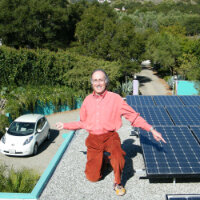
Energy Success Story: Film screening inspired Michel S. to buy a Leaf
Michel Saint-Sulpice is a gentle soul who takes his responsibility for the planet seriously, and always has. Growing up in France, his family was careful with resources, and he has carried forth that strong environmental ethic into his adult life as a Santa Barbara architect.
Michel aspires to be fossil fuel free by the end of 2012, and he’s well on his way. Solar panels provide his home with electricity, and he’s been driving a Toyota Prius since the second generation first hit the market. He completely removed his lawn to make room for a beautiful drought tolerant landscape. Greywater and collected rain water (with back-up well water) will soon irrigate a “food forest.” On the drawing board is a geothermal system that will heat the entire house (with cooling option), all his domestic water and his swimming pool year round. Since Michel produces all his electricity, his carbon footprint will be zero, and he will not be paying electric and gas bills any longer. He has taken these measures to express his deep appreciation for nature and beauty.